

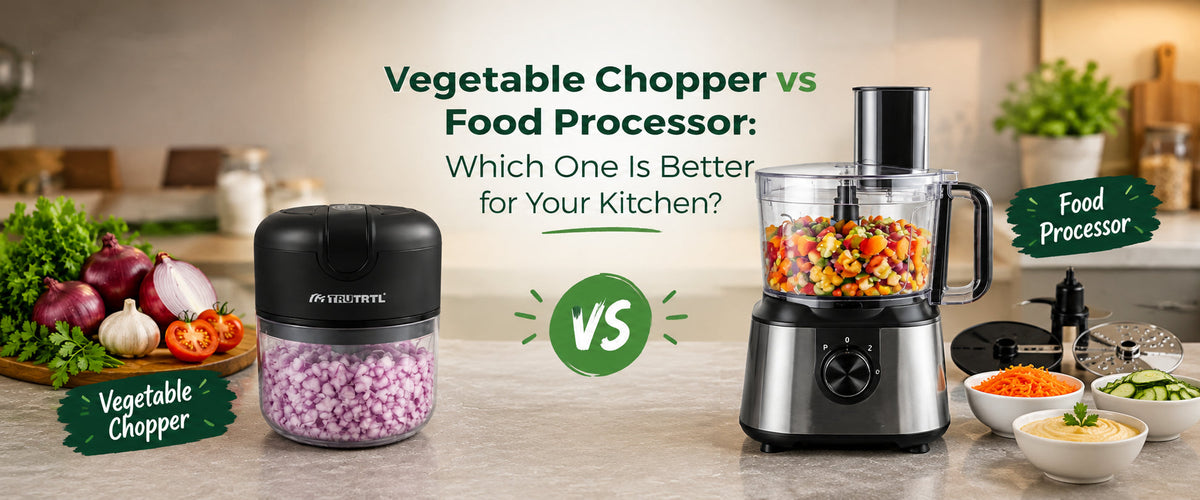
Vegetable Chopper vs Food Processor: Which One Is Better for Your Kitchen?
Sixty seconds. That is the exact difference between hand-chopping a pile of onions with tears streaming down your face and watching a machine reduce them to a fine mince. When you stand in your kitchen holding a sharp knife, you usually face a choice: a dedicated vegetable chopper or a full-sized food processor. One is a simple, targeted tool. The other is a heavy-duty multitasker.
What is the main difference between a vegetable chopper and a food processor?
A vegetable chopper is a compact tool—often manual—built for quickly cutting produce into uniform pieces, while a food processor is a versatile electric appliance that chops, slices, shreds, and purees through a feed tube. You choose a chopper for simple, small-batch prep, and a processor for complex, large-volume cooking.
According to KitchenAid, a food chopper usually relies on a single blade to chop, purée, and mix smaller batches. A food processor, by contrast, is larger and features a feed tube alongside multiple blades that make a variety of cuts. The difference comes down to scale and mechanical ambition. A chopper does one job fast. A processor does several jobs thoroughly.
Design and capacity variations
Capacity dictates how you cook. Food choppers generally hold about 5 cups of ingredients, making them compact enough to stash in a drawer or leave on the counter without losing workspace. Food processors are significantly larger. KitchenAid notes that residential food processor bowl capacities range widely from around 6 to 16 cups.
That extra volume changes what you can cook. If you meal-prep for the week, a 14-cup processor handles a mountain of carrots in one go. If you just need a half-cup of diced bell peppers for a Tuesday night stir-fry, pulling out a massive appliance feels like overkill.
Blade complexity and motor power
Choppers keep things simple. They use a single S-blade that pulses ingredients into submission. Food processors use that same S-blade for chopping and mixing, but they also accommodate interchangeable discs for slicing and shredding.
Chefs' Toys explains that commercial food processors cut ingredients with different types of spinning blades, and most feature a separate chute to add ingredients safely while the machine runs. The motors in food processors are also built to handle heavy resistance, meaning they can knead stiff dough or pulverize nuts into butter without straining. A chopper will stall out under that kind of pressure.
Can I use a food processor to chop vegetables?
Yes, you can absolutely use a food processor to chop vegetables. It handles bulk prep faster than a knife, utilizing an S-blade to process produce in seconds. However, it lacks the fine manual precision of a knife, so you must rely on short pulses to avoid turning your vegetables into an unrecognizable paste.
The WebstaurantStore guide points out that food processors are the most versatile machines for slicing, shredding, and mixing bulk ingredients. You drop whole vegetables through the feed tube, and the spinning discs do the heavy lifting. This makes the processor ideal for grating blocks of cheese or slicing a dozen zucchini for a large tray of lasagna.
Best foods to process
Some ingredients thrive in a food processor. Hard vegetables like carrots, potatoes, and onions process quickly. You can shred cheese, slice firm tomatoes, and even emulsify a thick vinaigrette. The machine excels at tasks that would normally exhaust your wrist.
Texture and consistency considerations
Texture control requires attention. A food processor moves fast. If you hold the button down too long, your sliced onions become a watery pulp. The ProctorSilex team notes that food processors offer more control over speed and precision when it comes to texture, but you still have to pulse carefully. Short, quick bursts give you chunky pieces. Longer runs give you purees.
Can a food chopper replace a food processor?
A food chopper can replace a food processor only if your cooking routine involves small volumes and basic cuts. It handles chopping, puréeing, and mixing perfectly well. It cannot replace a processor if you need to slice, shred, knead dough, or process large batches of food for batch cooking.
If you live alone or cook for two, a chopper might be the only motorized prep tool you need. It dices onions, crushes nuts, and blends small amounts of sauce. It takes up minimal space and washes in seconds.
When a chopper is enough
A chopper is enough when your goal is a quick finish. According to ProctorSilex, food choppers are relatively simple tools that excel at making vegetable or fruit purées, baby food, and thicker sauces. If you cook in small batches and rarely bake, a chopper covers your needs without cluttering your kitchen.
Tasks a chopper cannot handle
A chopper hits its limits quickly. It cannot shred a block of cheese. It cannot slice a cucumber into uniform rounds. It certainly cannot knead bread dough. KitchenAid specifies that food processors perform tasks food choppers just cannot do, like making nut butters and shredding large pieces of cheese. If you attempt to force a chopper to do these jobs, you will burn out the motor or end up with a lumpy, uneven mess.
Is it worth buying a vegetable chopper for daily use?
Yes, buying a vegetable chopper is worth it for daily use if you want to eliminate tedious knife work without the hassle of cleaning a large appliance. It saves time on small tasks, takes up almost no counter space, and washes in a fraction of the time it takes to clean a full food processor.
For everyday cooking, friction matters. If an appliance takes ten minutes to clean, you will not use it to chop a single onion. A chopper removes that friction.
Time-saving benefits for small tasks
Choppers cut prep time drastically. According to Chefs' Toys, when you do not want to spend ten minutes peeling and slicing one ingredient with a knife, a chopper is your best option for fast, small-batch prep. You drop the ingredient in, press the lid a few times, and you are done.
Cleanup and storage convenience
Storage is a major win for choppers. They fit inside a kitchen drawer. They usually feature fewer detachable parts than a food processor, meaning there are fewer nooks for food to get trapped. You can quickly rinse the bowl and blade, and you are ready for the next task.
Which is better for a small family: a food processor or a chopper?
For a small family, a vegetable chopper is usually the better choice unless you bake frequently or cook large-volume meals. It handles the daily demand of dicing onions, mincing garlic, and crushing nuts without the bulk of a food processor. If your family meal-preps in massive batches, however, a food processor is the smarter investment.
Families that cook together but eat in moderation do not need industrial capacity. They need efficiency.
Evaluating kitchen counter space
Counter space is premium real estate. Food processors demand a permanent spot on the counter or a dedicated shelf in the pantry because they are too large to tuck away easily. Choppers are small enough to live in a cabinet or drawer, only coming out when needed.
Matching appliance size to cooking habits
Look at how you actually cook. If you make soups from scratch every Sunday, a processor makes sense. If you chop a few vegetables on a weeknight to throw into a quick stir-fry, a chopper is the right fit. The Webstaurant Store guide emphasizes that choosing the right unit affects prep speed and helps you avoid paying for capacity you will not use in daily operation.
How do vegetable choppers and food processors compare in cleaning and maintenance?
Vegetable choppers are significantly easier to clean and maintain than food processors because they have fewer parts and lack complex feed tubes. Most chopper bowls and blades rinse clean in seconds, while food processors require full disassembly, careful handling of multiple sharp discs, and more intricate scrubbing to remove trapped food residue.
Safety and maintenance matter when you deal with sharp blades.
Dishwasher-safe components
Many modern choppers and processors feature dishwasher-safe components. You can detach the bowl and blade, place them on the top rack, and let the machine do the work. Still, the sheer number of parts in a food processor means you will spend more time loading and unloading the dishwasher.
Blade care and safety
Blades dull over time. Food processors use heavy stainless steel discs that stay sharp for years but require careful handling during storage so they do not nick your fingers. Choppers use a single S-blade that is easier to store safely but may need replacing if you use it daily on hard vegetables like carrots.
Should you buy a vegetable chopper, a food processor, or both?
You should buy both if your budget and kitchen space allow, because they serve entirely different purposes. Buy a vegetable chopper for quick, daily small-batch prep, and buy a food processor for heavy-duty tasks like shredding, slicing, and kneading. If you can only choose one, base your decision on how much you cook at once.
Having both tools creates a complete kitchen workflow.
Budget considerations
Budget plays a role, but the cost gap is wide. Choppers are affordable, targeted tools. Food processors cost more because they offer greater versatility. You have to decide if you need that versatility or if a simple blade will do the job.
TruTRTL kitchen solutions
Finding the right appliance changes how you cook. Whether you need a compact chopper for quick prep or a heavy-duty processor for family meals, TruTRTL offers reliable options to upgrade your kitchen. You can explore our range of kitchen bottles and accessories or find the perfect appliance for your home to match your daily cooking habits. If you have questions about which model fits your counter space, reach out to our team. You can also see what we are testing next on Facebook, Instagram, and YouTube.
Reviewed by the TruTRTL content team
Key Takeaways
- Choose a vegetable chopper for quick, small-batch prep and easy cleanup.
- Opt for a food processor to handle large volumes, slicing, shredding, and kneading.
- Food processors offer more texture control but require careful pulsing to avoid over-processing.
- A food chopper cannot fully replace a food processor for complex or heavy-duty tasks.
- Having both tools creates a complete and efficient kitchen workflow.
Comparison
|
Feature |
Vegetable Chopper |
Food Processor |
|
Capacity |
Small (up to 5 cups) |
Large (6 to 16 cups) |
|
Blade Complexity |
Single S-blade |
Multiple interchangeable discs and S-blades |
|
Best Uses |
Dicing onions, mincing garlic, small batches |
Shredding cheese, slicing vegetables, kneading dough |
|
Motor Power |
Handles light resistance |
Handles heavy resistance and thick doughs |
|
Cleanup & Storage |
Fits in a drawer, rinses clean in seconds |
Requires full disassembly, takes up counter space |
Frequently Asked Questions
Which is better, a food chopper or a food processor?
A food chopper is better for quick, small-batch prep like mincing garlic or dicing a single onion, saving you time and cleanup effort. A food processor is better for heavy-duty tasks, large volumes, shredding cheese, or kneading dough. Your choice depends on your daily cooking volume.
Can I use a chopper as a food processor?
You can use a chopper as a food processor only for basic chopping, puréeing, and mixing small batches. However, it cannot replace a food processor for slicing, shredding, or kneading dough. If you attempt to force a chopper to handle heavy tasks, you risk burning out the motor.
Is it worth buying a vegetable chopper?
Yes, buying a vegetable chopper is worth it if you want to eliminate tedious knife work without the hassle of cleaning a large appliance. It saves time on small daily tasks, takes up minimal counter space, and washes in a fraction of the time it takes to clean a processor.
Can I use a food processor to chop vegetables?
Yes, you can use a food processor to chop vegetables quickly using an S-blade. It handles bulk prep much faster than a knife. However, you must rely on short, quick pulses to maintain control over the texture and avoid turning your vegetables into an unrecognizable watery pulp.
What is the difference between a food processor and a vegetable chopper?
A vegetable chopper is a compact tool built for quickly cutting produce into uniform pieces, usually holding up to five cups. A food processor is a larger, versatile electric appliance featuring a feed tube and multiple blades for slicing, shredding, and pureeing large batches of food.

Share:
Air Fryer Temperature & Time Chart (for various foods)
Single-Wall vs Double-Wall Water Bottle: Which Should You Choose?